

What are Stem Cells?
Mesenchymal stem cells(MSC)
Adipose-derived stem cells are a type of mesenchymal stem cell
Stem cells are defined as cells that possess both self-renewal capacity and differentiation potential. Somatic stem cells refer to those stem cells present in the body.Somatic stem cells continuously generate new cells within specific tissues and organs, thereby maintaining and repairing tissues and contributing to homeostasis within the body.
Mesenchymal stem cells (MSCs) are a type of somatic stem cell with the ability to differentiate into mesenchymal lineages such as bone, cartilage, and adipose tissue. They are found in bone marrow, adipose tissue, and umbilical cord tissue. Among them, MSCs isolated from adipose tissue are called “adipose-derived stem cells.” TOPs cells correspond to this category of adipose-derived stem cells.
According to the regulatory framework, more than 1,000 regenerative medicine plans using autologous mesenchymal stem cells had been submitted to the Minister of Health, Labour and Welfare in Japan as of 2024, and the number continues to increase annually.
Note: There are also pluripotent stem cells, such as embryonic stem (ES) cells and induced pluripotent stem (iPS) cells, which can differentiate into a variety of cell types. ES cells, also known as embryonic stem cells, are derived by isolating and culturing the inner cell mass of embryos. iPS cells are artificially generated stem cells, created by introducing specific genes into somatic cells. Unlike somatic stem cells, these pluripotent stem cells have the ability to differentiate into many cell types. However, regenerative medicine using them is classified as “Type I Regenerative Medicine”, the highest risk category under the Act on the Safety of Regenerative Medicine in Japan, and thus requires different regulatory procedures compared with regenerative medicine using somatic stem cells.
Note on TOPs cells: TOPs cells are manufactured as Specific Processed Cells by culturing cells isolated from adipose tissue. Regular quality control has confirmed that they retain self-renewal capacity and multipotency. Therefore, they are considered to possess the same properties as stem cells under the conventional definition and are referred to as “mesenchymal stem cells.”
Biological Functions of Adipose-Derived Stem Cells
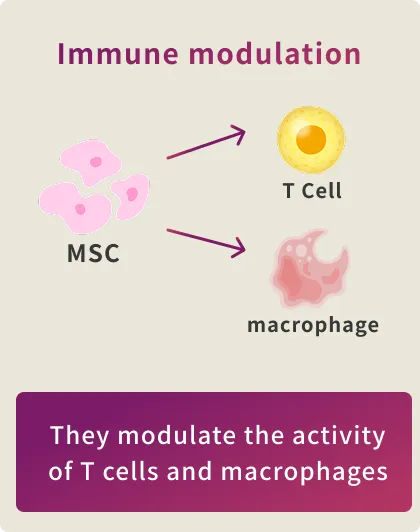
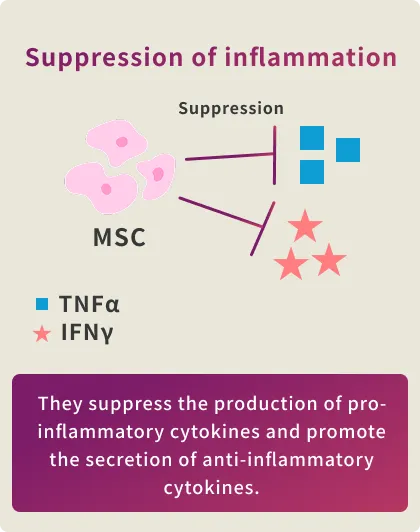
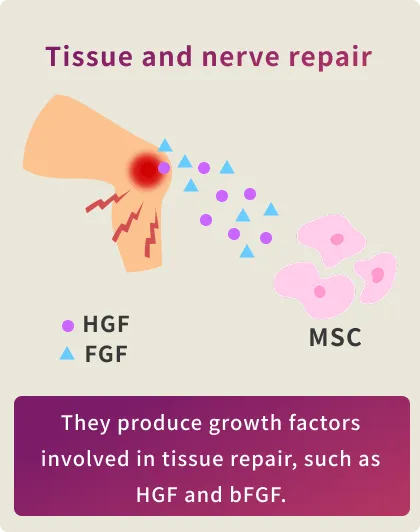

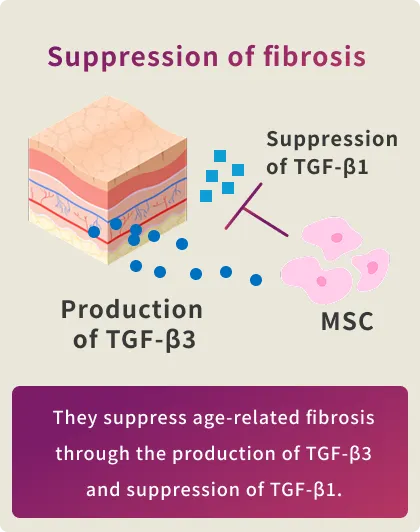
Adipose-derived stem cells administered into the body are thought to exert diverse effects, such as immunomodulation and tissue repair, by secreting various growth factors and cytokines in response to their surrounding environment and interacting with neighboring cells.
(Plast Reconstr Surg. 2023 Mar 1;151(3):420e-431e.)
(Dig Med Res. 2022 Dec 5:57)
(Stem Cells Int. 2020 Dec 10:2020:8810813.)
-
Stem cell therapy
-
What are Stem Cells?

-
Regenerative therapies with stem cells
-
-
 Cells
Cells
-
Implementing Facility